Richard Neuhaus reports the following anecdote of the late, great Cardinal Avery Dulles (requiescat in pace). Once when giving a talk at a parish church, the Cardinal noticed a large banner strung across the entrace that read "God is other people". His gut reaction was to take a magic marker to the sign and put an "emphatic comma" after the word "other". (Of course, he restrained himself.)
The attitude reflected in that banner, and the idea too frequently heard in a number of sermons, is that we find God in our fellow human beings or nowhere. It's almost as if, when asked what the greatest command of the law was, Jesus had answered: "Love the Lord your God with all of your heart, and all of your mind, and all of your strength; or, which is the same thing, love your neighbour as yourself." He didn't say that. Whether intentional or not, this kind of thinking can have the effect of directing us away from God and towards each other, towards ourselves. Now of course, "God is other people" is true in a sense. We serve God by means of loving service towards our neighbour: "What you do to the least of these, my brothers and sisters, you do to Me", said Our Lord. But this truth exists in tension with another, namely, that God is absolutely transcendent, infinitely surpassing our loftiest conceptions of Him: "For my thoughts are not your thoughts, nor are your ways my ways, says the LORD. As high as the heavens are above the earth, so high are my ways above your ways and my thoughts above your thoughts" (Isaiah 55:8-9). So we live in the tension between "God is other people" and "God is other, people". To embrace the first and ignore the second is to risk making what Father Neuhaus calls "the greatest of all category mistakes -- mistaking the creature for the Creator" (American Babylon, p. 100).
Father Neuhaus makes this point in the context of a discussion about the different forms atheism takes in our society. In a culture where bizarre neo-pagan spiritualities multiply at an ever-increasing rate, it's not always easy to tell who is and who is not an atheist. "Is a Zen physio-psychoanalyst an atheist?", he wonders. He continues:
"There are also curious twists and turns under ostensibly orthodox Christian auspices. References to transcendent realities are sometimes conflated with, and sometimes subordinated to, social agendas of great variety ... [this is where he inserts Cardinal Dulles's banner anecdote]. Whether under Christian or non-Christian auspices, many of the "spiritualities" in contemporary culture would seem to be elaborately religionized forms of atheism "(p. 100).
But we should also be cognizant of the fact that there are atheists worthy of our respect, "atheists in good faith", as Father Raniero Cantalamessa, preacher to the papal household, calls them. Neuhaus quotes him thus:
"The world of today knows a new category of people: the atheists in good faith, those who live painfully the situation of the silence of God, who do not believe in God but do not boast about it; rather they experience the existential anguish and the lack of meaning of everything: They too, in their own way, live in the dark night of the spirit. Albert Camus called them "the saints without God." The mystics exist above all for them; they are their travel and table companions. Like Jesus, they "sat down at the table of sinners and ate with them" (see Luke 15:2). This explains the passion with which certain atheists, once converted, pore over the writings of the mystics: Claudel, Bernanos, the two Maritains, L. Bloy, the writer J. K. Huysmans and so many others over the writings of Angela of Foligno; T. S. Eliot over those of Julian of Norwich. There they find again the same scenery that they had left, but this time illuminated by the sun.... The word "atheist" can have an active and a passive meaning. It can indicate someone who rejects God, but also one who -- at least so it seems to him -- is rejected by God. In the first case, it is a blameworthy atheism (when it is not in good faith), in the second an atheism of sorrow or of expiation." (Quoted on pp.104-105 of American Babylon)
Thursday, May 7, 2009

Tuesday, May 5, 2009
More from American Babylon
I can't remember where exactly (maybe in his book, Miracles?), but C. S. Lewis somewhere in his writings notes a certain incoherence in the philosophical stance of scientific materialism. Father Neuhaus in American Bablyon makes the same point in his usual inimitable manner:
"Yes, there are those who embrace simple-minded responses to the quandary [i.e., the mind-matter paradox]. In recent years, the "new atheists", as they are misleadingly called, such as Richard Dawkins, say that we human beings are nothing but "survival machines" and that what we call thought is nothing more than the product of neurosynapses in the pound of meat that is the brain. But, by their own account, they are programmed to talk that way, and, apart from our sympathy for their self-chosen plight, we need pay no mind to what they insist on describing as their mindlessness. Of course they protest that they are making an argument that has a claim upon our intellectual attention, but, try as we might, we cannot agree without denying the existence of the intellect that is the agent of our agreement" (p. 67-68).
My very first posting on this blog dealt with this sort of thing, and I don't want to repeat myself. Let me just say that for argument of any kind, scientific, ethical, theological, philosophical, whatever, to make sense, there must be a transcendent truth independent of human biology that we can access by means of our reason. This is possible because our minds are images of the Mind of the Maker, the source of all Truth. (And if we ever encounter extra-terrestrial intelligence, differences in biological makeup and evolutionary history will not be an insuperable impediment to our common pursuit of truth. Star Trek opens this Friday, so I had to throw that in!) Neuhaus expresses this idea beautifully: "The Catholic Augustinians ... were of the school of the logos , where it is understood that reason participates in the Mind of the Maker, and all that is truly real is love in response to the love by which all that is exists" (p. 72).
I love the way the man writes! I'll conclude this posting with one more quote that reinforces what was said earlier in a particularly compelling way:
"It is a striking oddity of our time that people who ground morality in choice are frequently the same people who claim that we have no choice. That is to say, they subscribe to the dismal idea that our lives and what we call our thoughts, purposes, and choices are all determined by matter in motion -- which is, finally, all that we are. At the same time, they subscribe to the idea of progress as the conquest of nature to, as Francis Bacon said, "relieve the estate of man."
"In short, we are completely captive to the nature we are determined to conquer. We are free to think and to choose, but our thinking and choosing is an illusion, since in reality they are no more than the transmission of impulses between the neurons of the "pound of meat" that is the brain. As the befuddled philosopher is supposed to have said, "As to the question of whether we have free will, we have no choice but to answer yes." This is self-referential contradiction and intellectual incoherence of a high order. It is at the core of the position that asserts with adamant certitude that there is no truth and that's the truth" (p. 77-78).
More on this in my next posting. (Oh, yeah, and the answer to the last "guess the author" is John Henry Newman. The passage is from one of his Parochial and Plain Sermons.)
"Yes, there are those who embrace simple-minded responses to the quandary [i.e., the mind-matter paradox]. In recent years, the "new atheists", as they are misleadingly called, such as Richard Dawkins, say that we human beings are nothing but "survival machines" and that what we call thought is nothing more than the product of neurosynapses in the pound of meat that is the brain. But, by their own account, they are programmed to talk that way, and, apart from our sympathy for their self-chosen plight, we need pay no mind to what they insist on describing as their mindlessness. Of course they protest that they are making an argument that has a claim upon our intellectual attention, but, try as we might, we cannot agree without denying the existence of the intellect that is the agent of our agreement" (p. 67-68).
My very first posting on this blog dealt with this sort of thing, and I don't want to repeat myself. Let me just say that for argument of any kind, scientific, ethical, theological, philosophical, whatever, to make sense, there must be a transcendent truth independent of human biology that we can access by means of our reason. This is possible because our minds are images of the Mind of the Maker, the source of all Truth. (And if we ever encounter extra-terrestrial intelligence, differences in biological makeup and evolutionary history will not be an insuperable impediment to our common pursuit of truth. Star Trek opens this Friday, so I had to throw that in!) Neuhaus expresses this idea beautifully: "The Catholic Augustinians ... were of the school of the logos , where it is understood that reason participates in the Mind of the Maker, and all that is truly real is love in response to the love by which all that is exists" (p. 72).
I love the way the man writes! I'll conclude this posting with one more quote that reinforces what was said earlier in a particularly compelling way:
"It is a striking oddity of our time that people who ground morality in choice are frequently the same people who claim that we have no choice. That is to say, they subscribe to the dismal idea that our lives and what we call our thoughts, purposes, and choices are all determined by matter in motion -- which is, finally, all that we are. At the same time, they subscribe to the idea of progress as the conquest of nature to, as Francis Bacon said, "relieve the estate of man."
"In short, we are completely captive to the nature we are determined to conquer. We are free to think and to choose, but our thinking and choosing is an illusion, since in reality they are no more than the transmission of impulses between the neurons of the "pound of meat" that is the brain. As the befuddled philosopher is supposed to have said, "As to the question of whether we have free will, we have no choice but to answer yes." This is self-referential contradiction and intellectual incoherence of a high order. It is at the core of the position that asserts with adamant certitude that there is no truth and that's the truth" (p. 77-78).
More on this in my next posting. (Oh, yeah, and the answer to the last "guess the author" is John Henry Newman. The passage is from one of his Parochial and Plain Sermons.)
Monday, May 4, 2009
Guess the author
Let us not be content with ourselves; let us not make our own hearts our home, or this world our home, or our friends our home; let us look out for a better country, that is, a heavenly country. Let us look out for Him Who alone can guide us to that better country; let us call heaven our home, and this life a pilgrimage; let us view ourselves as sheep in the trackless desert, who, unless they follow the shepherd, will be sure to lose themselves.
By the rivers of Babylon ...
First, a bit of history. Nabopolassar, the father of Nebuchadnezzar, laid the foundations for the Babylonian dynasty and empire in 626 B.C., and his son greatly extended it through conquest. Nineveh was taken and destroyed in 612 B.C. The kingdom of Judah was next, and Jerusalem was captured in 597. Nebuchadnezzar put Zedekiah on the throne as his proxy, at the same time exiling Ezekiel and thousands of others. In 586, the holy city was destroyed and almost all the remaining citizens were deported to captivity in Babylon. When Cyrus, king of Persia, conquered Babylon in 539, he permitted the Jews to return to their homeland to rebuild Jerusalem and, even more importantly, the temple.
The name Bablyon is the Greek version of the Akkadian Bab-Ilu, which translates as "gate of god". My fascination with languages prompts me to point out the similarities between 'Ilu', 'Allah', and 'Elohim', the words for God/god in Akkadian, Arabic, and Hebrew. The Hebrew word is plural in form (the -im ending), but is regularly used for God in the Hebrew Bible. For example, a recurring phrase is: 'ko amar Adonai Elohim Yisrael', 'Thus says the Lord, the God of Israel'. It might be a propos at this point to mention that in the Genesis account, Babylon is the place where the diversity of languages came to be. As we read in Genesis 11: "And the Lord said, "Behold, they are one people, and they have all one language; and this is only the beginning of what they will do; and nothing that they propose to do will now be impossible for them. Come, let us go down and there confuse their language, that they may not understand one another's speech.... and they left off building the city. Therefore its name was called Babel..."
So Babylon, symbolically, is the place where there is no communication, or at least, a place where communication is confused. A place where misunderstandings abound. And where there is no real communication, there is no real community. But human beings were made for community. Hence we are out of place in the world, restless in Babylon, and we long for a homeland where all misunderstandings, all lies will cease, where communication will be perfect, where human community will be perfected through our common community with God. We are all exiles here, on pilgrimage towards that perfect community that awaits us in the New Jerusalem. Hence we are not to get too comfortable here. Babylon is no place to settle down: 'Here we have no abiding city'. This is one of the principle points Father Neuhaus makes in his book, American Bablyon. But side by side with this we are enjoined to work for the well-being of this place of our exile, just as Jeremiah counselled the Jews in their Babylonian captivity:
"Build houses and live in them; plant gardens and eat the produce. Take wives and have sons and daughters ... multiply there, and do not decrease. But seek the welfare of the city where I have sent you into exile, and pray to the Lord on its behalf, for in its welfare you will find your welfare."
There is an obvious tension here, of which we should all be ever mindful. And there is an important difference between our situation and that of the Jews in Babylon, one that Father Neuhaus tends to pass over. The Jews were exiles in Babylon, but the Babylonians weren't. The Jews longed for their ancestral homeland; the Babylonians were home. We are not allowed to recognize such a distinction. We are all, without exception, exiles here, even those of us who don't realize it, who feel quite at home in the world. So when Neuhaus says: "To seek the peace and welfare of Babylon is to seek improvement, and another word for improvement in 'progress'. Devotion to progress is devotion to the common good, including the good of those citizens of Babylon who seek no other city" (p.58), I feel like responding, "Yes, but the greatest good we can do for them is to convince them that they don't belong in Babylon, that no one belongs in Babylon." Changing the metaphor a bit, we are commissioned by Our Lord to convince everyone to come with us into the Ark that is the Church, an Ark that can give us safe passage home.
The name Bablyon is the Greek version of the Akkadian Bab-Ilu, which translates as "gate of god". My fascination with languages prompts me to point out the similarities between 'Ilu', 'Allah', and 'Elohim', the words for God/god in Akkadian, Arabic, and Hebrew. The Hebrew word is plural in form (the -im ending), but is regularly used for God in the Hebrew Bible. For example, a recurring phrase is: 'ko amar Adonai Elohim Yisrael', 'Thus says the Lord, the God of Israel'. It might be a propos at this point to mention that in the Genesis account, Babylon is the place where the diversity of languages came to be. As we read in Genesis 11: "And the Lord said, "Behold, they are one people, and they have all one language; and this is only the beginning of what they will do; and nothing that they propose to do will now be impossible for them. Come, let us go down and there confuse their language, that they may not understand one another's speech.... and they left off building the city. Therefore its name was called Babel..."
So Babylon, symbolically, is the place where there is no communication, or at least, a place where communication is confused. A place where misunderstandings abound. And where there is no real communication, there is no real community. But human beings were made for community. Hence we are out of place in the world, restless in Babylon, and we long for a homeland where all misunderstandings, all lies will cease, where communication will be perfect, where human community will be perfected through our common community with God. We are all exiles here, on pilgrimage towards that perfect community that awaits us in the New Jerusalem. Hence we are not to get too comfortable here. Babylon is no place to settle down: 'Here we have no abiding city'. This is one of the principle points Father Neuhaus makes in his book, American Bablyon. But side by side with this we are enjoined to work for the well-being of this place of our exile, just as Jeremiah counselled the Jews in their Babylonian captivity:
"Build houses and live in them; plant gardens and eat the produce. Take wives and have sons and daughters ... multiply there, and do not decrease. But seek the welfare of the city where I have sent you into exile, and pray to the Lord on its behalf, for in its welfare you will find your welfare."
There is an obvious tension here, of which we should all be ever mindful. And there is an important difference between our situation and that of the Jews in Babylon, one that Father Neuhaus tends to pass over. The Jews were exiles in Babylon, but the Babylonians weren't. The Jews longed for their ancestral homeland; the Babylonians were home. We are not allowed to recognize such a distinction. We are all, without exception, exiles here, even those of us who don't realize it, who feel quite at home in the world. So when Neuhaus says: "To seek the peace and welfare of Babylon is to seek improvement, and another word for improvement in 'progress'. Devotion to progress is devotion to the common good, including the good of those citizens of Babylon who seek no other city" (p.58), I feel like responding, "Yes, but the greatest good we can do for them is to convince them that they don't belong in Babylon, that no one belongs in Babylon." Changing the metaphor a bit, we are commissioned by Our Lord to convince everyone to come with us into the Ark that is the Church, an Ark that can give us safe passage home.
Friday, May 1, 2009
St. Joseph the Worker
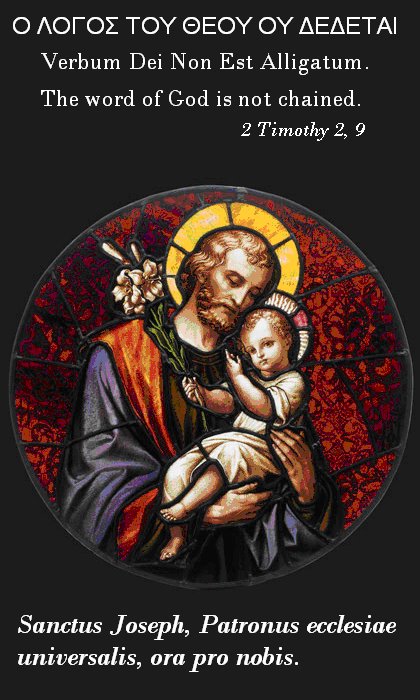
I know I said that my next few posts would be on Father Neuhaus's book, American Babylon, but today is the feast of St. Joseph the Worker, and I can't let that pass without acknowledgement. The Office of Readings for today (May 1) doesn't speak about St. Joseph specifically: there is instead a passage from Gaudium et Spes on the value and dignity of human labour. So I'll quote something from the Office of Readings from March 19, the saint's solemnity. This is from a sermon by Saint Bernardine of Siena:
"There is a general rule concerning all special graces granted to any human being. Whenever the divine favor chooses someone to receive a special grace, or to accept a lofty vocation, God adorns the person chosen with all the gifts of the Spirit needed to fulfill the task at hand.
"This general rule is especially verified in the case of Saint Joseph, the foster-father of our Lord and the husband of the Queen of our world, enthroned above the angels. He was chosen by the eternal Father as the trustworthy guardian and protector of his greatest treasures, namely, his divine Son and Mary, Joseph's wife. He carried out this vocation with complete fidelity until at last God called him, saying: Good and faithful servant, enter into the joy of your Lord.
"What then is Joseph's position in the whole Church of Christ? Is he not a man chosen and set apart? Through him and, yes, under him, Christ was fittingly and honorably introduced into the world. Holy Church in its entirety is indebted to the Virgin Mother because through her it was judged worthy to receive Christ. But after her we undoubtedly owe special gratitude and reverence to Saint Joseph.
"In him the Old Testament finds its fitting close. He brought the noble line of patriarchs and prophets to its promised fulfillment. What the divine goodness had offered as a promise to them, he held in his arms.
"... Remember us, Saint Joseph, and plead for us to your foster-child. Ask your most holy bride, the Virgin Mary, to look kindly upon us, since she is the mother of him who with the Father and the Holy Spirit lives and reigns eternally. Amen."
"There is a general rule concerning all special graces granted to any human being. Whenever the divine favor chooses someone to receive a special grace, or to accept a lofty vocation, God adorns the person chosen with all the gifts of the Spirit needed to fulfill the task at hand.
"This general rule is especially verified in the case of Saint Joseph, the foster-father of our Lord and the husband of the Queen of our world, enthroned above the angels. He was chosen by the eternal Father as the trustworthy guardian and protector of his greatest treasures, namely, his divine Son and Mary, Joseph's wife. He carried out this vocation with complete fidelity until at last God called him, saying: Good and faithful servant, enter into the joy of your Lord.
"What then is Joseph's position in the whole Church of Christ? Is he not a man chosen and set apart? Through him and, yes, under him, Christ was fittingly and honorably introduced into the world. Holy Church in its entirety is indebted to the Virgin Mother because through her it was judged worthy to receive Christ. But after her we undoubtedly owe special gratitude and reverence to Saint Joseph.
"In him the Old Testament finds its fitting close. He brought the noble line of patriarchs and prophets to its promised fulfillment. What the divine goodness had offered as a promise to them, he held in his arms.
"... Remember us, Saint Joseph, and plead for us to your foster-child. Ask your most holy bride, the Virgin Mary, to look kindly upon us, since she is the mother of him who with the Father and the Holy Spirit lives and reigns eternally. Amen."
Tuesday, April 28, 2009
Father Richard Neuhaus
I recently finished reading Father Neuhaus's last book, American Babylon. I love that man. I always said to myself that if I ever got to New York, I'd go to one of his masses and listen to him preach. That will never happen now, sadly. I mourn his passing. I pray, I trust, that having fought the good fight, having run his race, he has reached the longed-for home, the goal he describes in such moving language: "The pilgrim destination is not so much a place as a person. How do Christians envision their final return from exile? It is the personal encounter and eternal dwelling with one who is no stranger, for we knew him in his humility and will then see him in his triumph. The finite, once receptive to the infinite, is now received into the infinite. Received, not absorbed or subsumed, for we continue to be creatures, but now creatures perfectly attuned to the love by which and for which we were made."
I'll be reflecting on his book in my next few postings. In this, as in everything he wrote, there is a lot to chew on. But today, I just want to quote the last two paragraphs:
"Throughout these pages, the proposal is that the whole creation groans for the glory that is to be revealed. With the resurrection of Jesus, a genuinely new world order has been inaugurated, and we are on the way, out from exile and on the pilgrim way toware the City of God. We are sustained on the way by faith's embrace of the presence in time of the End Time, who is the Alpha and Omega, the logos of all that has been, is now, and ever shall be. We are moving toward our destination, and our destination is moving toward us. At the very end of the very last book of the Bible are the words of Jesus, "Behold, I am coming soon." To which all the saints respond: "Amen. Come, Lord Jesus!"
"... we seek to be faithful in a time not of our choosing but of our testing. We resist the hubris of presuming that it is the definitive time and place of historical promise or tragedy, but it is our time and place. It is a time of many times: a time for dancing, even if to the songs of Zion in a foreign land; a time for walking together, unintimidated when we seem to be a small and beleaguered band; a time for rejoicing in momentary triumphs, and for defiance in momentary defeats; a time for persistance in reasoned argument, never tiring in proposing to the world a more excellent way; a time for generosity toward those who would make us their enemy; and, finally, a time for happy surrender to brother death -- but not before, through our laughter and our tears, we see and hail from afar the New Jerusalem and know that it is all time toward home."
Amen to that, Father! Richard John Neuhaus. Requiescat in pace.
I'll be reflecting on his book in my next few postings. In this, as in everything he wrote, there is a lot to chew on. But today, I just want to quote the last two paragraphs:
"Throughout these pages, the proposal is that the whole creation groans for the glory that is to be revealed. With the resurrection of Jesus, a genuinely new world order has been inaugurated, and we are on the way, out from exile and on the pilgrim way toware the City of God. We are sustained on the way by faith's embrace of the presence in time of the End Time, who is the Alpha and Omega, the logos of all that has been, is now, and ever shall be. We are moving toward our destination, and our destination is moving toward us. At the very end of the very last book of the Bible are the words of Jesus, "Behold, I am coming soon." To which all the saints respond: "Amen. Come, Lord Jesus!"
"... we seek to be faithful in a time not of our choosing but of our testing. We resist the hubris of presuming that it is the definitive time and place of historical promise or tragedy, but it is our time and place. It is a time of many times: a time for dancing, even if to the songs of Zion in a foreign land; a time for walking together, unintimidated when we seem to be a small and beleaguered band; a time for rejoicing in momentary triumphs, and for defiance in momentary defeats; a time for persistance in reasoned argument, never tiring in proposing to the world a more excellent way; a time for generosity toward those who would make us their enemy; and, finally, a time for happy surrender to brother death -- but not before, through our laughter and our tears, we see and hail from afar the New Jerusalem and know that it is all time toward home."
Amen to that, Father! Richard John Neuhaus. Requiescat in pace.
Monday, April 27, 2009
Silence
I've been trying to track down something I read in Thomas Merton a long time ago on contemptus mundi. No luck so far. But in the process, I came upon some wonderful passages in his book, Contemplative Prayer on the importance of silence. I'd like to share a couple of these. The first is from Isaac of Niniveh, a Syrian monk:
"Many are avidly seeking but they alone find who remain in continual silence ... Every man who delights in a multitude of words, even though he says admirable things, is empty within. If you love truth, be a lover of silence. Silence like the sunlight will illuminate you in God and will deliver you from the phantoms of ignorance. Silence will unite you to God himself ...
"More than all things love silence: it brings you a fruit that tongue cannot describe. In the beginning we have to force ourselves to be silent. But then there is born something that draws us to silence. May God give you an experience of this 'something' that is born of silence. If only you practice this, untold light will dawn on you in consequence .. after a while a certain sweetness is born in the heart of this exercise and the body is drawn almost by force to remain in silence."
Further on, Merton quotes one of the Desert Fathers, Abba Ammonas, a disciple of St. Anthony:
"Behold, my beloved, I have shown you the power of silence, how thoroughly it heals and how fully pleasing it is to God. Wherefore I have written to you to show yourselves strong in this work you have undertaken, so that you may know that it is by silence that the saints grew, that it was because of silence that the power of God dwelt in them, because of silence that the mysteries of God were known to them."
In relation to the subject of contemptus mundi and withdrawal from worldly attachments, this passage is not exactly what I had in mind, but it is very relevant (I'm quoting Merton himself this time):
"Far from establishing one in unassailable narcissistic security, the way of prayer brings us face to face with the sham and indignity of the false self that seeks to live for itself alone and to enjoy the 'consolation of prayer' for its own sake. This 'self' is pure illusion, and ultimately he who lives for and by such an illusion must end either in disgust or in madness.
"On the other hand, we must admit that social life, so-called 'worldly life,', in its own way promotes this illusory and narcissistic existence to the very limit. The curious state of alienation and confusion of man in modern society is perhaps more 'bearable' because it is lived in common, with a multitude of distractions and escapes -- and also with opportunities for fruitful action and genuine Christian self-forgetfulness. But underlying all life is the ground of doubt and self-questioning which sooner or later must bring us face to face with the ultimate meaning of our life. This self-questioning can never be without a certain existential 'dread' -- a sense of insecurity, of 'lostness,' of exile, of sin. A sense that one has somehow been untrue not so much to abstract moral or social norms but to one's own inmost truth. 'Dread' in this sense is not simply a childish fear of retribution, or a naive guilt, a fear of violating taboos. It is the profound awareness that one is capable of ultimate bad faith with himself and with others: that one is living a lie."
It's a very strong idea in monastic spirituality that life in the "world", if it doesn't actually force us to live a lie, does tend to keep drawing us up to the surface of things. We have to break contact at times if we want to get down to the depths of reality, where the encounter with God can occur. Again, Merton says this better than I can: "[the monk] plunges deep into the heart of that world of which he remains a part although he seems to have "left" it. In reality the monk abandons the world only in order to listen more intently to the deepest and most neglected voices that proceed from its inner depth."
"Many are avidly seeking but they alone find who remain in continual silence ... Every man who delights in a multitude of words, even though he says admirable things, is empty within. If you love truth, be a lover of silence. Silence like the sunlight will illuminate you in God and will deliver you from the phantoms of ignorance. Silence will unite you to God himself ...
"More than all things love silence: it brings you a fruit that tongue cannot describe. In the beginning we have to force ourselves to be silent. But then there is born something that draws us to silence. May God give you an experience of this 'something' that is born of silence. If only you practice this, untold light will dawn on you in consequence .. after a while a certain sweetness is born in the heart of this exercise and the body is drawn almost by force to remain in silence."
Further on, Merton quotes one of the Desert Fathers, Abba Ammonas, a disciple of St. Anthony:
"Behold, my beloved, I have shown you the power of silence, how thoroughly it heals and how fully pleasing it is to God. Wherefore I have written to you to show yourselves strong in this work you have undertaken, so that you may know that it is by silence that the saints grew, that it was because of silence that the power of God dwelt in them, because of silence that the mysteries of God were known to them."
In relation to the subject of contemptus mundi and withdrawal from worldly attachments, this passage is not exactly what I had in mind, but it is very relevant (I'm quoting Merton himself this time):
"Far from establishing one in unassailable narcissistic security, the way of prayer brings us face to face with the sham and indignity of the false self that seeks to live for itself alone and to enjoy the 'consolation of prayer' for its own sake. This 'self' is pure illusion, and ultimately he who lives for and by such an illusion must end either in disgust or in madness.
"On the other hand, we must admit that social life, so-called 'worldly life,', in its own way promotes this illusory and narcissistic existence to the very limit. The curious state of alienation and confusion of man in modern society is perhaps more 'bearable' because it is lived in common, with a multitude of distractions and escapes -- and also with opportunities for fruitful action and genuine Christian self-forgetfulness. But underlying all life is the ground of doubt and self-questioning which sooner or later must bring us face to face with the ultimate meaning of our life. This self-questioning can never be without a certain existential 'dread' -- a sense of insecurity, of 'lostness,' of exile, of sin. A sense that one has somehow been untrue not so much to abstract moral or social norms but to one's own inmost truth. 'Dread' in this sense is not simply a childish fear of retribution, or a naive guilt, a fear of violating taboos. It is the profound awareness that one is capable of ultimate bad faith with himself and with others: that one is living a lie."
It's a very strong idea in monastic spirituality that life in the "world", if it doesn't actually force us to live a lie, does tend to keep drawing us up to the surface of things. We have to break contact at times if we want to get down to the depths of reality, where the encounter with God can occur. Again, Merton says this better than I can: "[the monk] plunges deep into the heart of that world of which he remains a part although he seems to have "left" it. In reality the monk abandons the world only in order to listen more intently to the deepest and most neglected voices that proceed from its inner depth."
Subscribe to:
Posts (Atom)